
Proper Seating at the Piano
Balance, Support, and Freedom of Movement
Proper seating at the piano is not about holding the body in a rigid or fixed posture. It is about establishing a balanced relationship with the instrument that allows the pianist to move freely, efficiently, and comfortably.
Before playing the first note, the pianist should consider three fundamental questions:
Where am I sitting on the bench? How am I balanced? Can I move freely?
A well-organized sitting position allows the torso, arms, hands, and entire body to participate naturally in piano playing.
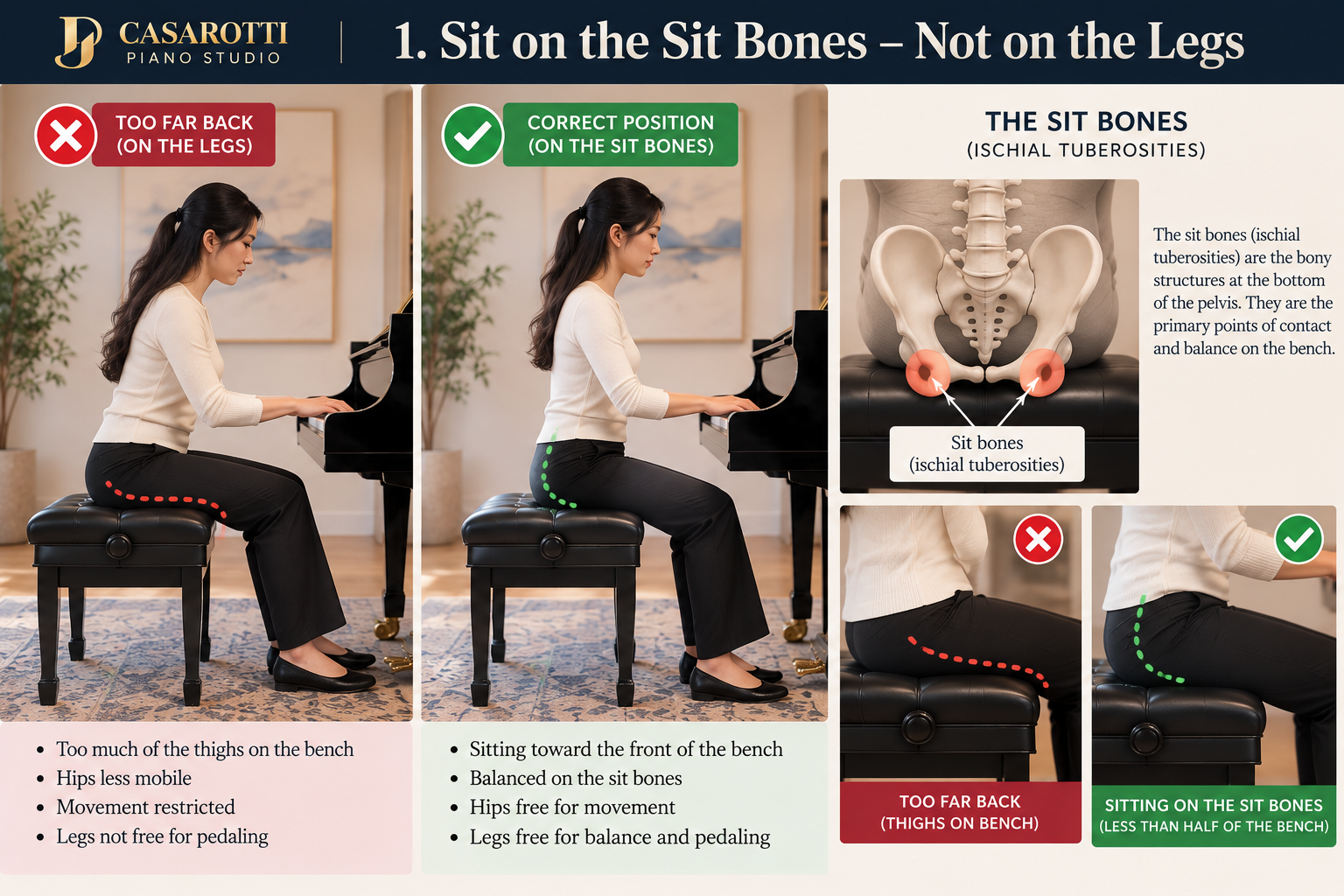
1. Sit on the Sit Bones—not on the Legs
One of the most important concepts in piano seating is understanding where the body meets the bench.
The primary points of contact and balance on the bench should be the two sit bones, anatomically known as the ischial tuberosities.
These are the bony structures at the bottom of the pelvis that you can feel underneath you when sitting on a firm surface.
Sit Bones = Ischial Tuberosities
When properly seated, the pianist is balanced primarily through the left and right sit bones, rather than resting a large portion of the thighs on the bench.
This distinction is extremely important.
If too much of the thighs and legs are supported by the bench, the pelvis may become less mobile and movement from the hip joints can become restricted.
The legs need to remain available for balance, movement, and pedaling.
Think of the sit bones as the pianist's two primary points of balance on the bench.
2. Sit Toward the Front of the Bench
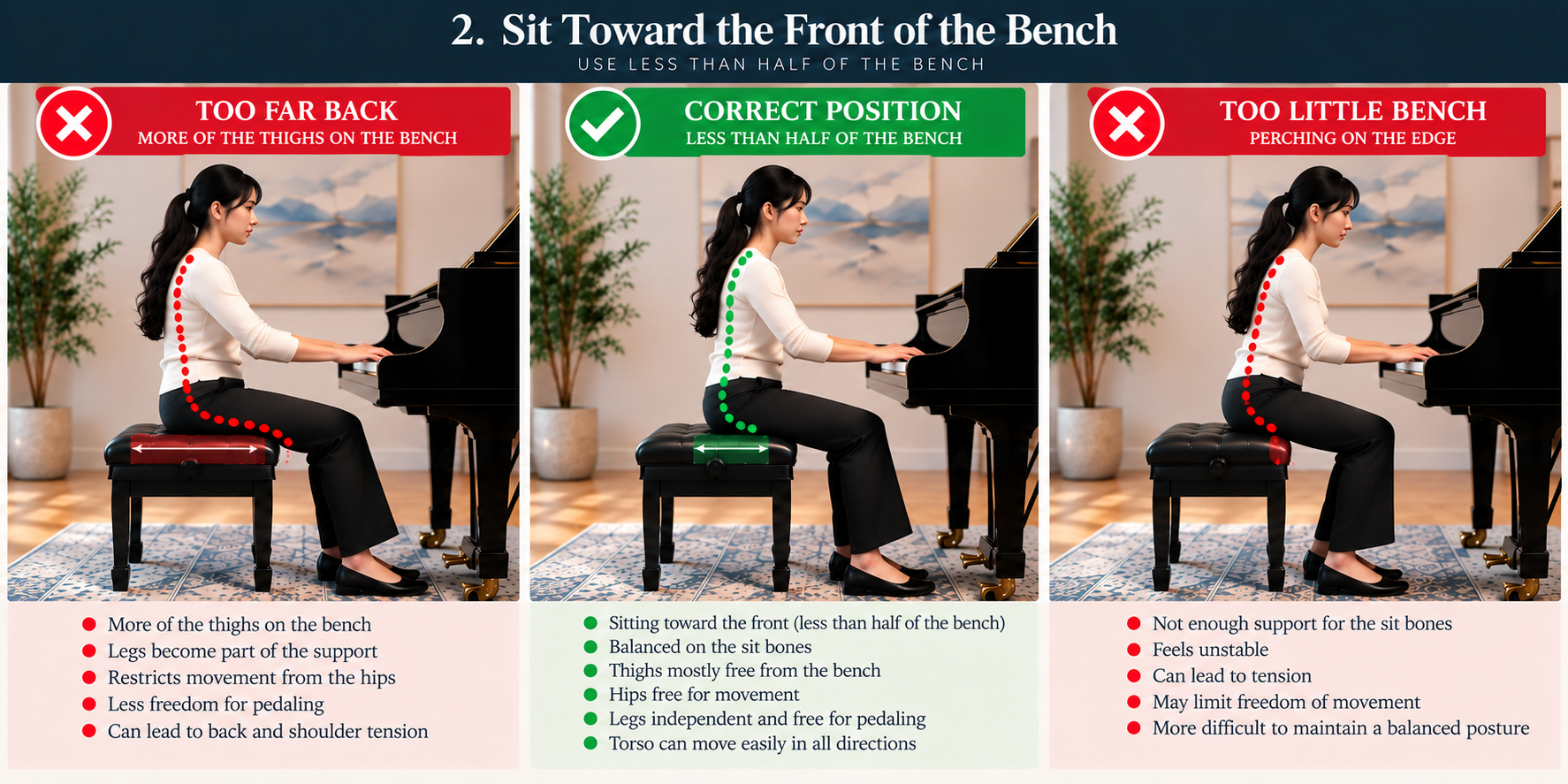
A pianist generally does not need to sit on half—or more—of the piano bench.
Instead, sit toward the front of the bench, usually on less than half of its depth, while maintaining secure contact through the sit bones.
This does not mean perching precariously on the very edge.
The goal is to find the place where:
both sit bones are securely supported;
the thighs are not unnecessarily resting on the bench;
the hip joints remain free;
the legs can move independently;
the torso can move easily in every direction.
The bench provides the foundation, but it should not immobilize the pianist.
Too Far Back
Sitting too far back places more of the thighs on the bench. This can make the legs part of the seated support and restrict freedom at the hip joints.
Better Position
Move forward until the sit bones provide the primary contact with the bench and the legs remain free.
This creates a much more dynamic foundation for piano playing.
3. The Six Points of Balance at the Piano
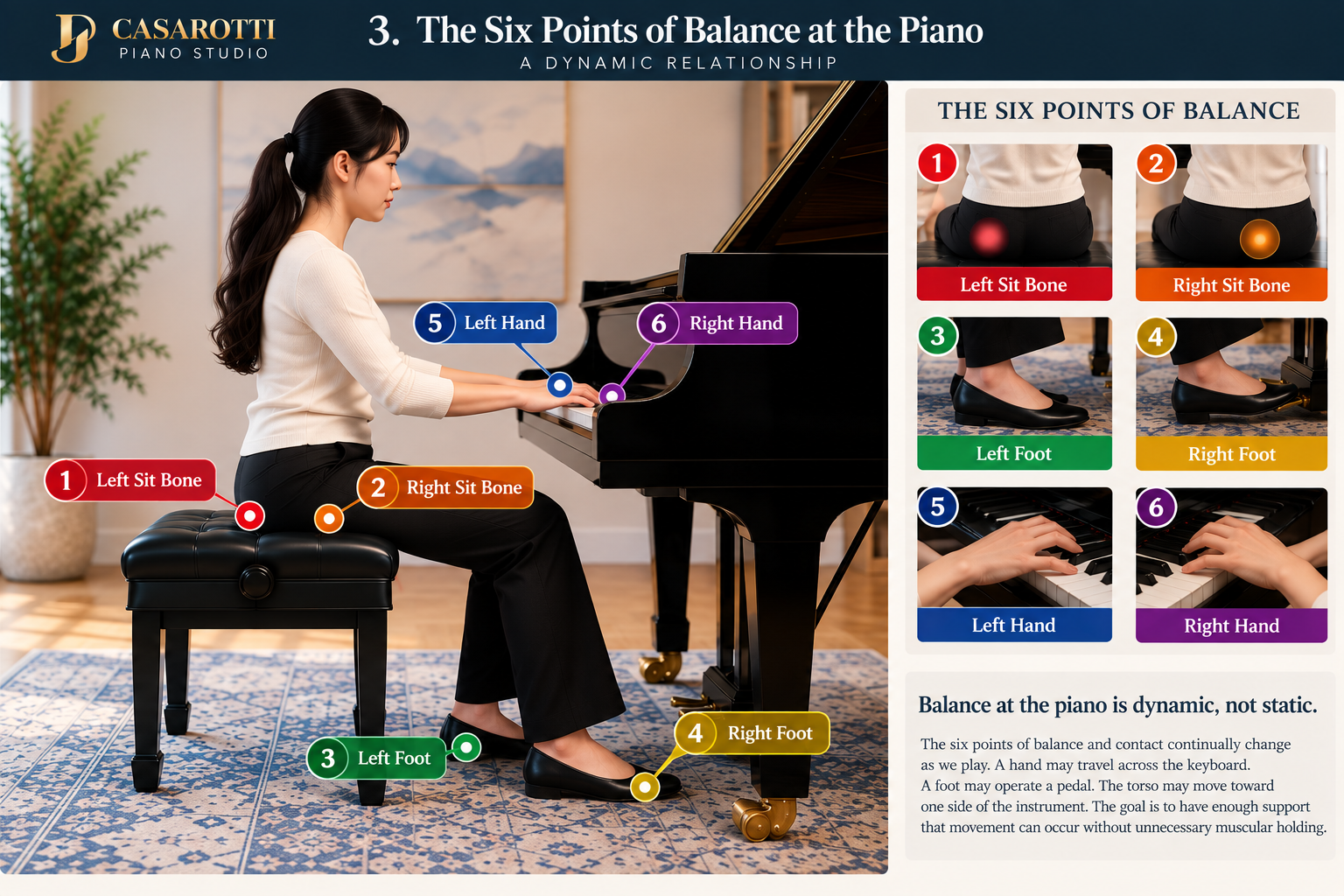
I like to think of the pianist as having six points of balance and contact while playing:
1. Left sit bone — contact with the bench
2. Right sit bone — contact with the bench
3. Left foot — contact with the floor or footrest
4. Right foot — contact with the floor or footrest
5. Left hand — contact with the keyboard
6. Right hand — contact with the keyboard
Together, these six points create a dynamic relationship between the pianist, the bench, the floor, and the instrument.
They are not six rigid anchors.
As we play, the amount of support and contact at each point continually changes. A hand may travel across the keyboard. A foot may operate a pedal. The torso may move toward one side of the instrument. The relationship among all six points continually reorganizes.
Balance at the piano is dynamic, not static.
The objective is not to remain perfectly centered and motionless. It is to have enough support that movement can occur without unnecessary muscular holding.
4. Find the Correct Distance from the Piano
After establishing your position on the bench, determine the appropriate distance from the keyboard.
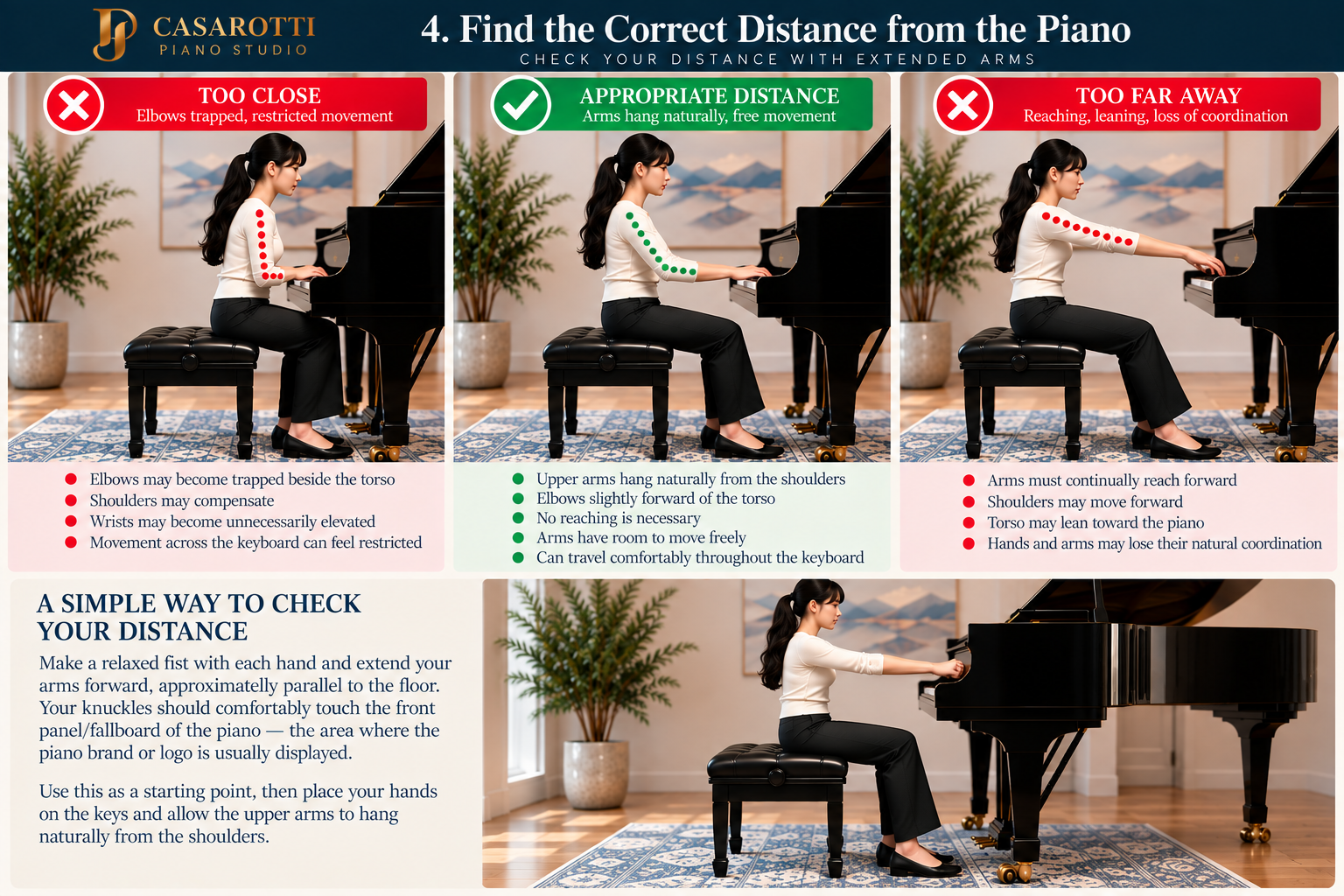
A Simple Way to Check Your Distance
Make a relaxed fist with each hand and extend your arms forward, approximately parallel to the floor. Your knuckles should comfortably reach the front panel/fallboard of the piano—the area where the piano brand or logo is usually displayed.
Use this as a starting point rather than a rigid measurement. Individual body proportions may require a small adjustment.
Then place your hands comfortably on the keys and allow the upper arms to hang naturally from the shoulders.
The pianist should be close enough that reaching is unnecessary, but far enough away that the elbows and arms have room to move freely.
Too Close
When sitting too close:
the elbows may become trapped beside or behind the torso;
the shoulders may compensate;
the wrists may become unnecessarily elevated;
movement across the keyboard can feel restricted.
Too Far Away
When sitting too far away:
the arms must continually reach forward;
the shoulders may move forward;
the torso may lean toward the piano;
the hands and arms may lose their natural coordination.
Appropriate Distance
At an appropriate distance, the upper arms can hang naturally from the shoulders, with the elbows generally slightly forward of the torso.
The pianist should be able to move freely throughout the keyboard without reaching forward or feeling crowded by the piano.
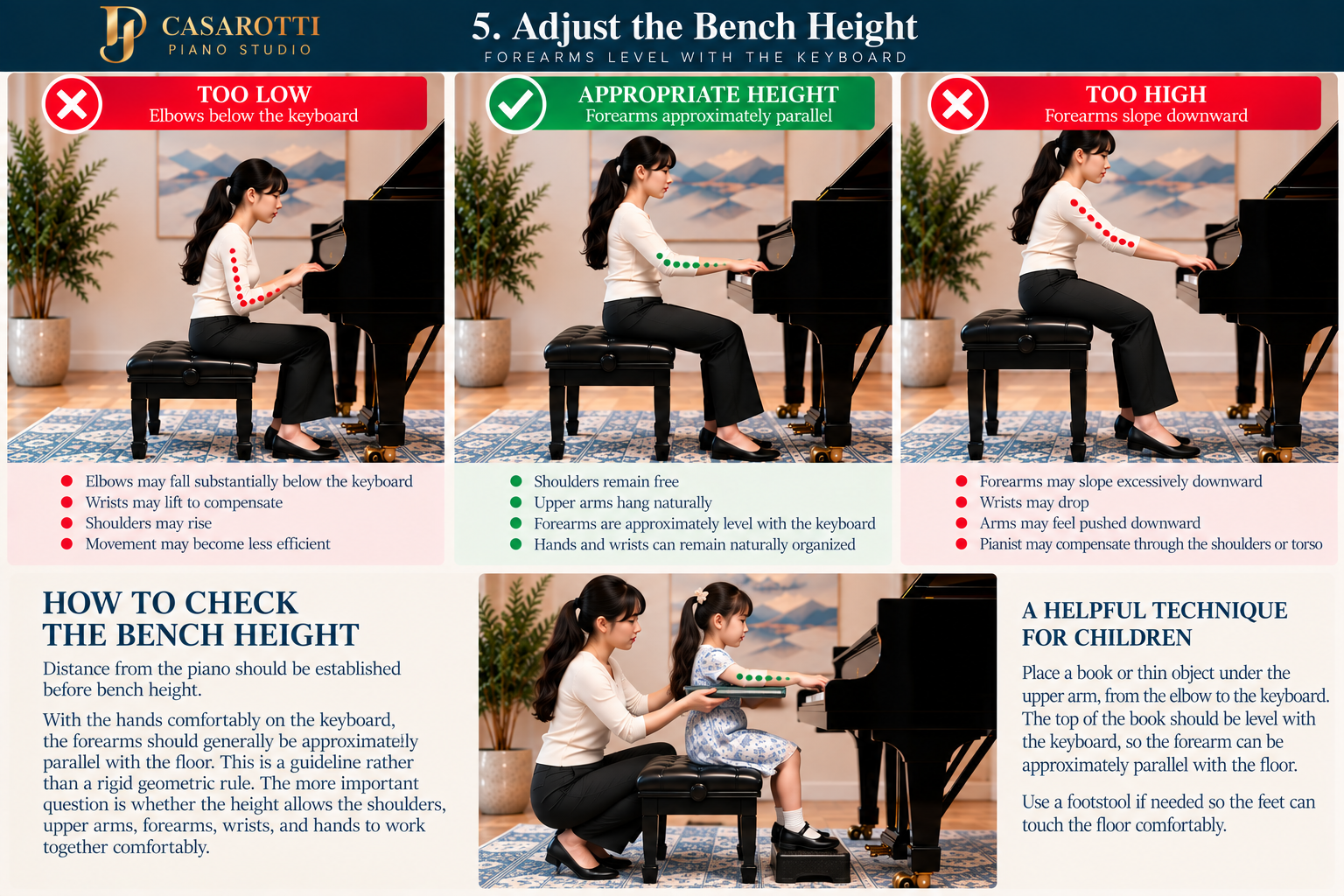
5. Adjust the Bench Height
Distance should be established before bench height.
Once the pianist is sitting on the sit bones at an appropriate distance from the piano, evaluate the height of the bench.
With the hands comfortably on the keyboard, the forearms should generally be approximately parallel with the floor.
This is a guideline rather than a rigid geometric rule.
The more important question is whether the height allows the shoulders, upper arms, forearms, wrists, and hands to work together comfortably.
Too Low
When the bench is too low:
the elbows may fall substantially below the keyboard;
the wrists may lift to compensate;
the shoulders may rise;
movement may become less efficient.
Too High
When the bench is too high:
the forearms may slope excessively downward;
the wrists may drop;
the arms may feel pushed downward;
the pianist may compensate through the shoulders or torso.
Appropriate Height
At a well-adjusted height:
the shoulders remain free;
the upper arms can hang naturally;
the forearms are approximately level with the keyboard;
the hands and wrists can remain naturally organized.
6. The Feet Are Part of the Pianist's Foundation
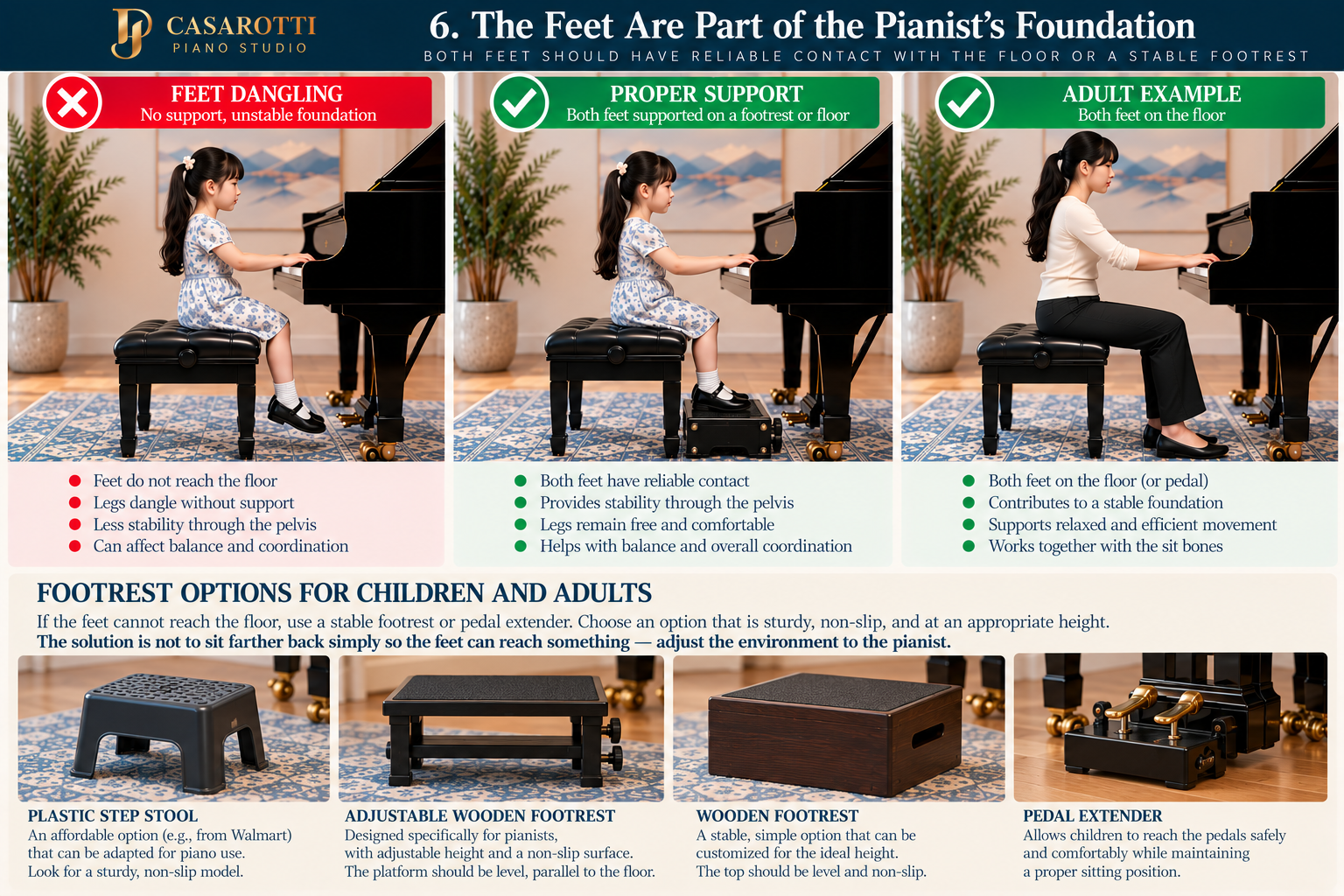
The feet are not passive while sitting at the piano.
Together with the two sit bones, they contribute to the pianist's physical foundation.
Whenever possible, both feet should have reliable contact with either the floor or a stable footrest.
This becomes particularly important for children.
If a child's feet cannot reach the floor, allowing them to dangle removes two important points of support.
A properly adjusted footrest or pedal extender can provide the support necessary for the child to remain balanced through the pelvis while keeping the legs free.
The solution is not to sit farther back simply so the feet can reach something.
Instead, adjust the environment to the pianist.
7. Keep the Hip Joints Available for Movement
Sitting on the sit bones toward the front of the bench allows the hip joints to remain free.
This is essential because piano playing requires movement throughout the keyboard.
The torso needs to be able to move:
forward and backward, left and right, and toward different registers of the keyboard.
The pianist should not attempt to keep the torso permanently upright and motionless.
Good posture is not stillness.
Good posture creates possibilities for movement.
8. Allow the Upper Arms to Hang Naturally
The shoulders should not be deliberately pushed down, pulled backward, or held in a particular position.
Instead, allow the upper arms to hang naturally from the shoulder joints.
An inappropriate bench height or distance can often create what appears to be a shoulder problem.
Before telling a student to “relax the shoulders,” first examine:
the bench position, distance, height, and overall balance.
Changing the environment may eliminate the need for the body to compensate.
9. Hand–Wrist–Forearm Alignment
The hand, wrist, and forearm should function as a coordinated unit.
Rather than forcing the wrist into a perfectly straight position, look for a natural relationship among these structures.
The wrist should not habitually collapse downward or remain unnecessarily elevated.
Likewise, the fingers do not need to be forced into an artificial curve.
Healthy organization allows the pianist to maintain alignment while still having the freedom to make the many small adjustments required by the music.
10. Balance Changes as We Play
Proper seating does not mean finding one perfect position and remaining there.
Consider playing at the extreme ends of the keyboard.
If the pianist remains completely stationary in the middle of the bench and simply reaches with the arms, coordination becomes increasingly difficult.
Instead, the entire body participates.
The torso can move laterally. The relationship between the two sit bones changes. The feet provide support. The arms travel. The hands continually establish new contact with the keyboard.
The pianist remains balanced while moving.
This is why the six points of balance are so useful: they help us understand piano playing as an integrated activity involving the entire body.
11. Every Pianist Is Different
There is no single bench measurement that works for everyone.
Pianists differ in:
overall height;
torso length;
upper-arm and forearm length;
leg length;
hand size;
age and stage of physical development.
Two pianists who are exactly the same height may require different bench settings.
Children also require frequent adjustments as they grow.
The objective is therefore not to reproduce someone else's seating position. It is to understand the principles of balance well enough to find the appropriate setup for your own body.
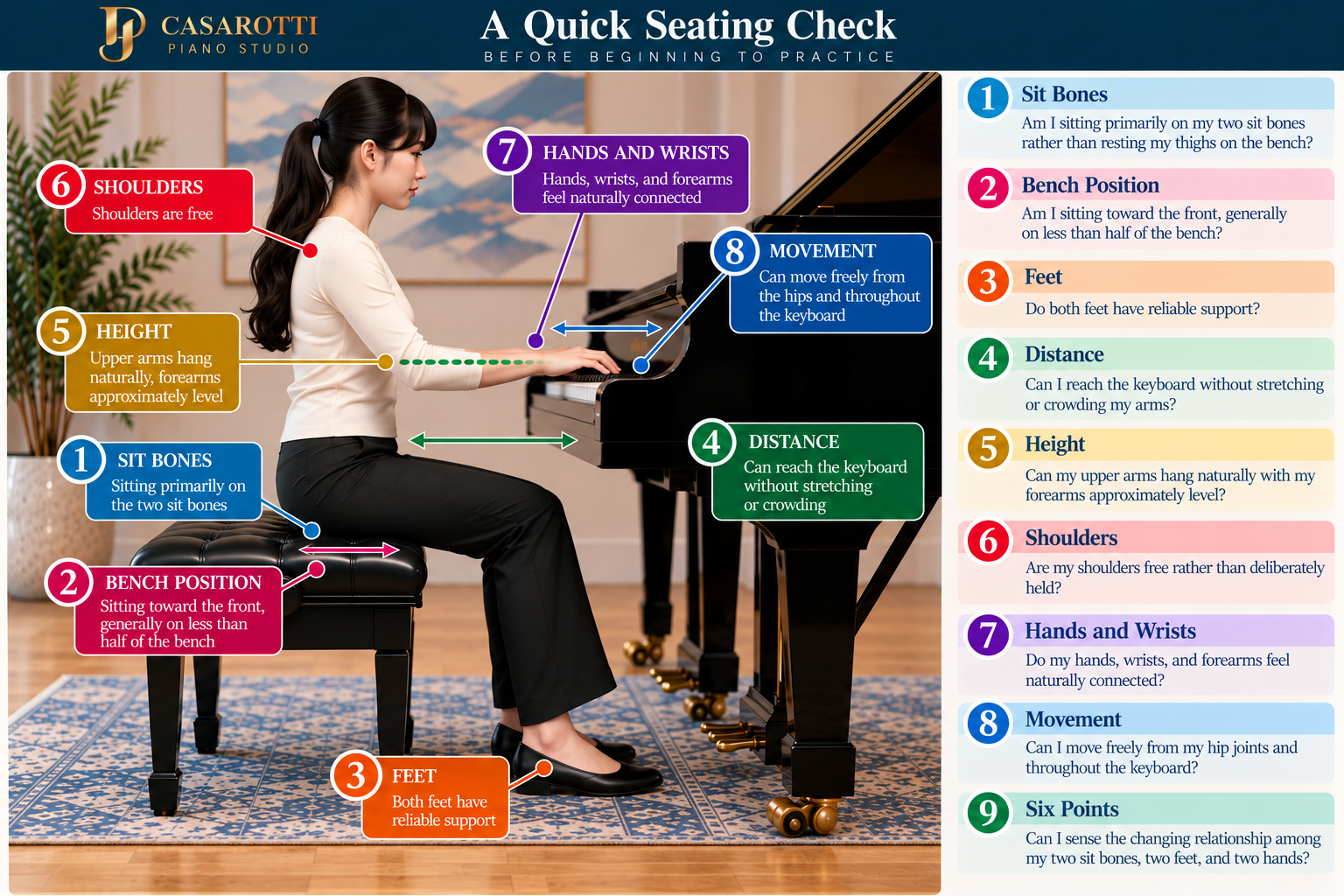
A Quick Seating Check
Before beginning to practice, ask yourself:
Sit Bones — Am I sitting primarily on my two sit bones rather than resting my thighs on the bench?
Bench Position — Am I sitting toward the front, generally on less than half of the bench?
Feet — Do both feet have reliable support?
Distance — Can I reach the keyboard without stretching or crowding my arms?
Height — Can my upper arms hang naturally with my forearms approximately level?
Shoulders — Are my shoulders free rather than deliberately held?
Hands and Wrists — Do my hands, wrists, and forearms feel naturally connected?
Movement — Can I move freely from my hip joints and throughout the keyboard?
Six Points — Can I sense the changing relationship among my two sit bones, two feet, and two hands?
Technique Begins with Balance
Healthy piano technique begins before a note is played.
The two sit bones provide the primary points of contact with the bench. The feet provide support from the floor, and the hands establish our connection with the instrument.
Together, these six points of balance create a dynamic foundation for playing.
The purpose of proper seating is not to hold the pianist in a perfect posture.
It is to create a stable yet flexible foundation from which the pianist can move freely, coordinate efficiently, and communicate expressively through the instrument.